
Leadwork
Leadwork and Lead Flashing Repairs, Done Properly Not Patched
Flashing is where most roof leaks actually start. We renew and repair lead around chimneys, walls and valleys so water goes where it's meant to.
Service overview
What is involved in leadwork
Lead flashing does a small but critical job on a roof, sealing the gap where a roof slope meets something upright, a chimney, a wall, a dormer cheek. When it's fitted properly it lasts for decades, but when it's patched with sealant instead of properly dressed and pointed, it fails within a season or two and starts letting water in.
We get called out a lot across Coventry, Solihull and Rugby to fix flashing that's been botched with mastic or roofing sealant as a quick fix by a previous roofer. Sealant cracks in the sun, shrinks in the cold, and never bonds properly to brickwork long term. We remove it, rake the joint out properly and dress new lead in, tucked into the mortar course so it's mechanically fixed rather than just stuck.
Soakers are the small individual pieces of lead woven between tiles or slates at a junction, most commonly where a roof meets a wall on the side rather than the top. They're less visible than a chimney flashing but just as important, and when they corrode or come loose they cause leaks that are tricky to trace without getting up close.
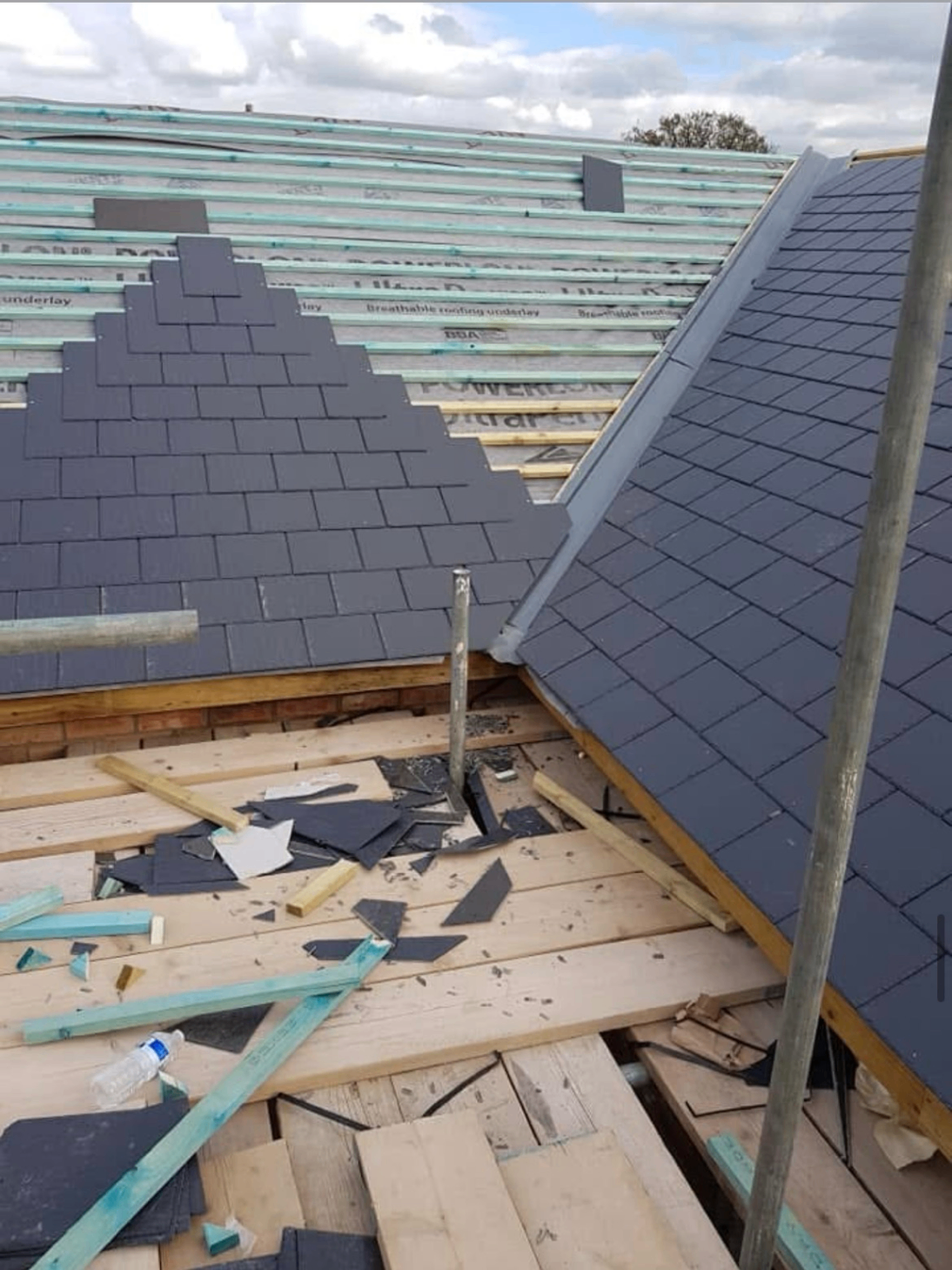
Valleys, where two roof slopes meet, take more water flow than anywhere else on the roof, so lead valleys need to be the right width and properly lapped to cope with heavy rain. A cracked or undersized valley will show up as a leak lower down the roof, sometimes well away from the actual fault, which catches people out.
We work with code 4 and code 5 lead depending on the location and exposure, following standard lap and fixing practice so the work holds up to wind uplift and thermal movement over years, not just months. On older Warwick and Kenilworth properties we take care matching detailing to what's typical for the age of the building.
Cost depends on how much lead needs renewing, access, and whether we're repairing an isolated section or renewing flashing around an entire chimney or roof junction. We'll always inspect properly and give you a free written quote rather than guessing from the ground.
- Code 4 and code 5 lead flashing installation
- Chimney and wall abutment flashing repairs
- Lead valleys, soakers and step flashing
- Removal of failed sealant patch repairs
- Flat roof lead detailing and dressing
- Free written quotes for repair or full renewal
You will deal with our team from the first visit until the work is finished.
Signs your leadwork may need attention
Signs your leadwork may need attention
Lead rarely fails dramatically. It usually gives warning signs first: a damp patch on a chimney breast, staining down an internal wall where a roof meets an abutment, water appearing after driving rain but not after light showers, or a leak that keeps coming back in the same place after being sealed. Lifted, rippled or slipped flashing after a windy spell is another common sign, as is white or chalky residue on brickwork below a flashing line.
Inside the loft, look for damp timbers or daylight around a chimney, a valley or the junction with a neighbouring wall. Outside, sealant or mastic smeared along a flashing line is almost always a sign that a previous repair has papered over a fault rather than fixed it.
Leadwork is used at more places on a roof than most people realise: chimney and wall abutment flashing, step flashing and soakers along party walls, lead valleys between two slopes, back gutters behind chimney stacks, dormer cheeks and small lead-covered sections over bays and porches. Flat and pitched roofs both rely on these details, and on many extensions the leak turns out to be the abutment flashing rather than the roof covering itself.
We repair and renew chimney flashing, valleys and abutment leadwork across Coventry, Solihull, Warwick, Rugby, Nuneaton, Kenilworth and Leamington Spa as well as the surrounding villages.
Repair or replace, and how we decide
Repair or replace, and how we decide
Not every leadwork fault needs new lead. Where flashing has simply worked loose from the mortar course, or a short length has split, a targeted repair, re-dressing and repointing the joint properly, is often the sensible fix. Where lead is thin with age, split in several places, undersized for the detail, or has been patched repeatedly with sealant, renewing that section usually works out better value than repairing it again.
The only way to advise honestly is to look at the detail up close, so an inspection is normally needed before we can say which applies. We check the condition of the lead, the mortar joint it sits in, the tiles or slates around it and the timber beneath where we can see it.
Once we have inspected, you get a free written quote explaining what we recommend, what we would renew and what we would leave alone. Call us or send an enquiry through the form on this page to arrange a visit.
Common problems
Problems we put right
The faults we see most often when homeowners ask us about leadwork.
Sealant used instead of proper flashing
A quick sealant patch might stop a leak for a few months, but it cracks and shrinks, and once it fails water gets straight in again. We remove these and dress in proper lead instead.
Corroded or split lead
Very old lead can split or develop pinholes with age, especially on flatter sections where it doesn't shed water quickly. Once it's split, it needs renewing rather than repairing.
Lead theft or missing flashing
Lead flashing is sometimes stolen from roofs, leaving an exposed gap that lets water straight in. We can assess and replace it quickly, and provide documentation for insurance purposes.
Undersized or poorly lapped valleys
A valley that's too narrow or not lapped correctly for the roof pitch can overflow in heavy rain, sending water under the tiles either side rather than down the valley itself.
Our process
How we work, step by step
- 1
You get in touch about a leak or damaged flashing
Tell us where you're seeing water or where flashing looks damaged, and we'll arrange to inspect it properly rather than guessing over the phone.
- 2
We inspect the leadwork up close
Using proper access equipment we check the condition of existing lead, soakers and valleys, and identify exactly where water is getting in.
- 3
Free written quote
We explain what needs renewing or repairing, the grade of lead we'll use, and give you the price and any guarantee in writing.
- 4
Leadwork fitted and dressed properly
We remove failed material, rake out joints where needed, and dress new lead in with correct laps and fixings so it's built to last.
Why choose us
Benefits of choosing The Roofing Lads
Proper dressing, not sealant
We fit lead correctly into raked joints rather than relying on sealant, so the fix actually lasts through winters rather than needing redoing.
Code 4 and code 5 lead
We use the right grade of lead for the location and exposure, following standard practice for laps and fixings.
Fully insured
Leadwork often involves working at height around chimneys and valleys, and our team carries public liability insurance throughout.
Written guarantees
Any guarantee on leadwork is confirmed in writing with your quote, so you know exactly what's agreed.
Flashing problems are easy to miss from the ground, and easy for a previous repair to have papered over with sealant rather than fixing properly. If you've had a persistent leak that keeps coming back, it's worth having the leadwork checked properly rather than patched again.
We cover leadwork repairs and renewals across Coventry, Solihull, Warwick, Leamington Spa, Rugby, Nuneaton and Kenilworth, including the older Regency and Victorian roofs around central Leamington Spa where lead detailing has to be matched carefully. Get in touch and we'll inspect it properly and give you a free written quote for doing it right.
Service area
Where we work
We cover Coventry and the surrounding Midlands. Call us if your postcode is nearby and we will let you know.
- Coventry
- Birmingham
- Solihull
- Warwick
- Leamington Spa
- Rugby
- Nuneaton
- Bedworth
- Kenilworth
- Stratford-upon-Avon
- West Midlands
Related work
Other roofing services
Chimney Repairs & Repointing
Repointing, flaunching, pots and flashings, keeping the chimney watertight and structurally sound.
Read moreRoof Repairs
Slipped slates, leaks and storm damage put right by our own team, with a free written quote before any work starts.
Read moreFlat Roofing
Felt, EPDM and GRP flat roofs installed and repaired across Coventry and Warwickshire.
Read moreTalk to the team
Need help with leadwork?
Call 07547 893951. Give us a call and tell us what is going on.
FAQs